
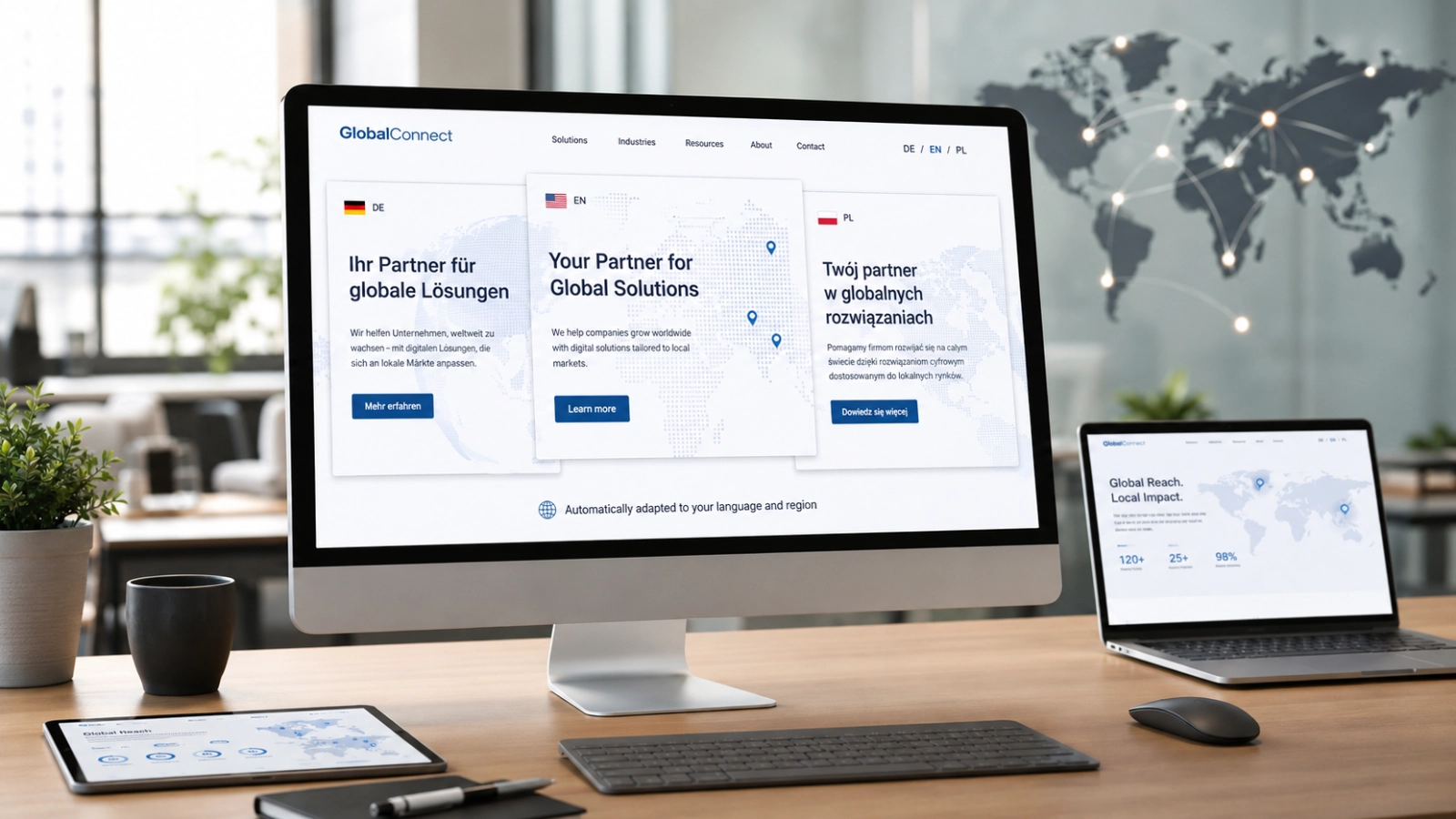
Your website speaks your visitors' language
Internationalisation
We create multilingual websites and configure them to display content automatically in your visitors' preferred language – for a professional international presence.
Multilingual websites for customers across language boundaries
Companies no longer reach only visitors from their own language region through the internet. Customers, prospects, business partners and employees expect information in a language they can understand with confidence.
We therefore design your website for multiple languages from the outset or extend an existing web project with a structured internationalisation solution. Content, navigation and interface elements are provided according to language while remaining part of one shared website.
Multiple languages within one website
Instead of building a technically separate website for every language, different language versions can be managed within one shared application. Structure, functionality and design remain consistent.
Text, navigation, notifications, forms and additional content are displayed according to the selected language. New functionality therefore does not need to be developed separately for every language version.
Automatically detect the preferred language
On a visitor's first visit, the website can take the browser's language preferences into account. If a corresponding language version is available, the appropriate content can be displayed automatically.
German-, English- or Polish-speaking visitors, for example, can therefore be presented with the appropriate language version immediately without first having to make a manual selection.
Visitors can change the language at any time
Automatic language selection provides a convenient starting point but does not replace the visitor's own choice. A clearly accessible language selector allows users to switch to another available language whenever required.
The selected language can be stored for subsequent page views so that the website remembers the visitor's preference instead of reverting to the browser language during every navigation.
Manage content specifically for each language
Good internationalisation involves more than simply replacing individual words. Headings, text, forms, messages, page titles and other content need to be managed consistently for every supported language.
A structured separation between application code and translatable content makes language versions easier to maintain, extend and update. Additional languages can also be added later without unnecessarily complicating the application.
Consider international visibility
Multilingual websites also have specific requirements for search engines. Language assignment, page titles, descriptions, internal links and the technical identification of alternative language versions should therefore be considered from the outset.
A clean technical structure helps search engines understand the different language versions correctly and direct visitors to the most appropriate version.
Internationalisation as part of the technical architecture
Multilingual functionality is most reliable when it is not added separately to individual pages afterwards, but is considered as part of the web application's architecture from the beginning.
Language-dependent content, URLs, navigation, forms and user preferences can then work together consistently while the technical foundation remains open to additional languages and future extensions.
Components of a multilingual website
Depending on your target audiences, content and existing website, different internationalisation functions can be combined.
- Multilingual pages, navigation and interface elements
- Automatic detection of the preferred browser language
- Manual language selection by the visitor
- Storage of the visitor's selected language
- Structured management of language-specific content
- Technical preparation for international search engine optimisation
- Easy expansion with additional languages
- Setup, maintenance and technical support
Internationalisation tailored to your target markets
Not every website requires the same languages, and not every piece of content necessarily has to be structured identically in every language version. Your audiences, markets and business requirements determine the appropriate approach.
We develop a multilingual structure tailored to your web project and provide your visitors with a professional, understandable and consistent experience – regardless of which supported language they use.